
We all know that artificial intelligence is reshaping how buyers discover information online. Search behavior is becoming more conversational. AI-generated summaries are reducing clicks. Platforms like ChatGPT, Gemini, Claude, and Perplexity are influencing how users research products, vendors, and solutions before they even visit a website.
For marketers, especially in B2B industries, that shift has created a common question: “How do we optimize for AI search?”
I get it. It’s a fair question. But in many cases, the conversation quickly drifts toward the how before addressing something more important:
What actually makes a company discoverable in the first place?
Because despite all the discussion around AI search optimization, generative engine optimization (GEO), and AI-driven discovery, the underlying principles of effective marketing have not changed nearly as much as many people assume.
The channels are evolving. The interfaces are changing. The search experience is becoming more dynamic.
But the businesses that continue to surface consistently are still the ones that:
- Solve the problems
- Communicate their expertise
- Publish useful, quality content
- Understand what their audience is looking for
- Build trust continually
The technology may look different, but the fundamentals remain quite familiar.
AI Search Is Growing Quickly, Especially in B2B Research
According to research referenced in multiple industry reports, traditional search engine volume could decline by 25% in 2026 as users increasingly adopt AI chatbots and virtual agents for information discovery. At the same time, Adobe Digital Insights reported a 693% year-over-year increase in AI-driven referral traffic to U.S. retail websites during the 2025 holiday season.
In B2B specifically, AI search behavior is already influencing how buyers evaluate vendors and gather information:
- AI-generated summaries are reducing reliance on traditional SERPs
- Buyers are asking longer, more contextual questions
- Search visibility is increasingly dependent on content clarity and authority
Research also suggests that AI search results pull from a wider and less predictable mix of sources than traditional search engines. A recent academic study examining Google Search, AI Overviews, and Gemini found substantial differences in the sources surfaced by generative AI compared to standard search results.
For marketers, this means visibility is no longer tied only to rankings. Rather, it’s increasingly tied to whether your content can be interpreted, summarized, and trusted by AI platforms.
What Has Not Changed
This is where many marketing conversations become unnecessarily complicated. While AI search may alter how information is surfaced, it does not eliminate the need for strong marketing basics.
In a recent episode of Confessions of a Mad Marketer, Marty McDonald, Co-Founder of Bad Rhino, explained it this way:
“All the same stuff you would do for an effective SEO campaign is the same thing. It’s just rebranded as AI search.”
That perspective may sound overly simple at first, but the underlying point is important.
Strong discoverability still depends on:
- Content that’s clear, useful, and relevant
- Alignment with your audience
- Showing authority & credibility
- Content that is structured in a way that can be searched by SERPs
- Publishing consistently, keeping it fresh
- User experience that’s easy to navigate
AI search tools still need identifiers to understand:
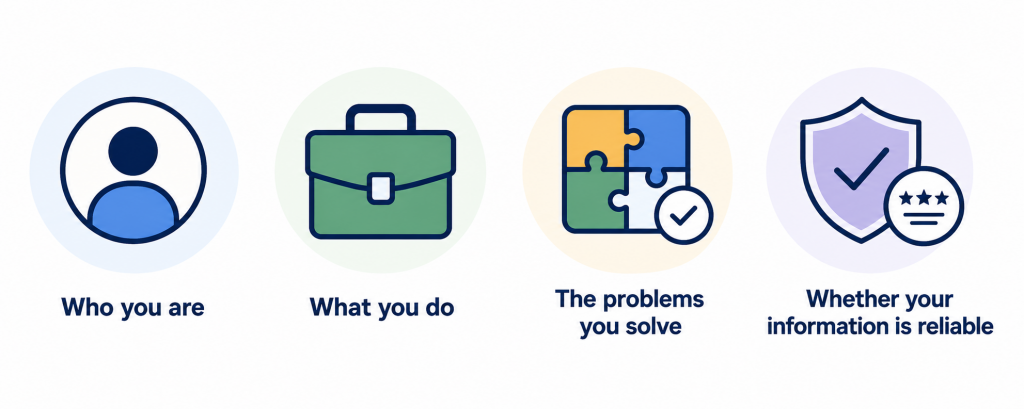
In many ways, AI search raises the importance of content quality rather than reducing it.
Why Audience Understanding Matters More Than Ever
One of the more significant shifts happening right now is behavioral. AI allows buyers to research independently and more efficiently than ever before. That changes how marketers need to think about their content strategy.
Buyers are no longer searching with short keywords, but asking nuanced questions.
So, instead of searching: “industrial automation software”
A user now may ask: “What industrial automation platform integrates best with legacy manufacturing systems for mid-sized operations?”
That creates a totally different content environment. And, the companies most likely to come up in these moments are the ones creating content that:
- answer detailed questions
- address specific industry pain points
- reflect expertise on the subject or topic
- mirror the language their buyers actually use
- demonstrate a total understanding of their audience
This is especially important in B2B markets where multiple stakeholders influence buying decisions. For example, a CFO, ops leader, plant manager, engineer, procurement lead, and marketing exec may all approach the same solution from different perspectives. So, the messaging must not be generic.
AI Is Increasing the Value of Expertise
One of the unintended outcomes of generative AI is content saturation.
Creating content is easier than ever.
Creating meaningful content is NOT.
As AI-generated articles, summaries, and low-value content continue to flood the internet, it is vital to differentiate with:
- Specific expertise
- Deep knowledge of the industry
- Insights that are exclusive to your business
- Personal experiences
The challenge is not simply producing more content. It’s producing more useful content.
The Role of Industry Media and Trusted Publishing Environments
This shift also reinforces the value of established industry media brands. As AI systems prioritize authority, trust, and context, credible publishing platforms become increasingly important on how brands are discovered and validated.
That applies not only to owned content, but also to:
- Contributed articles and editorial partnerships
- Sponsored thought leadership
- Webinars
- Podcasts
- Educational resources
- Event participation
Visibility needs to extend beyond traditional advertising impressions. It needs to include how often your expertise appears within trusted industry conversations. For B2B organizations, this means media strategy and content strategy are becoming more interconnected.
Discovery Is Changing. Buyer Expectations Are Too.
Modern buyers expect:
- Educational content
- Immediate answers
- Industry experts
- Practical guidance
- Credibility without being sales-y
And, AI search is accelerating those expectations. That means brands relying heavily on vague positioning, overly promotional messages, and superficial content may struggle to remain visible as discovery evolves.
Meanwhile, organizations investing in educational resources, audience-forward content, and integrated marketing strategies are more likely to benefit from the transition.
A Conversation Worth Watching
This topic came up during a recent Confessions of a Mad Marketer conversation between BNP Media and Marty McDonald of Bad Rhino.
One of the more interesting takeaways from the discussion was not that AI changes everything. It was that marketers sometimes overcomplicate what effective visibility actually requires.
The technology evolves quickly. Buyer behavior changes constantly.
But businesses still need to answer the same core questions clearly:
- What problem do you solve?
- Why should buyers trust you?
- What makes you unique?
- Who is your solution actually for?
Where Marketing Teams Should Focus Next
AI search will continue changing how buyers discover information. There’s no question about that. But for most B2B organizations, the answer is not abandoning proven marketing principles in favor of entirely new tactics.
The best approach is usually:
- Improve the quality of your content
- Get a deeper understanding of your audience
- Strengthen your authority in your industry
- Create more useful educational resources
- Align your topics with the intent of your buyer
- And, maintain visibility across channels consistently
Because while AI may change how discovery happens, it still depends on the same foundational signals marketers have been building for years. And in many cases, the companies best positioned for AI discovery are simply the ones that already understand their audience better than everyone else.
Image via Envato Elements, by africaimages.