B2B marketers deal with plenty of things that can keep us up at night.
Budgets get cut. Leads disappear. Campaigns underperform. Sales wants more leads. Leadership wants more revenue. Buyers are researching in places we cannot always see or measure.
And somehow, marketing is still expected to explain exactly what worked.
In honor of Halloween, here are a few of the things that should genuinely scare B2B marketers.
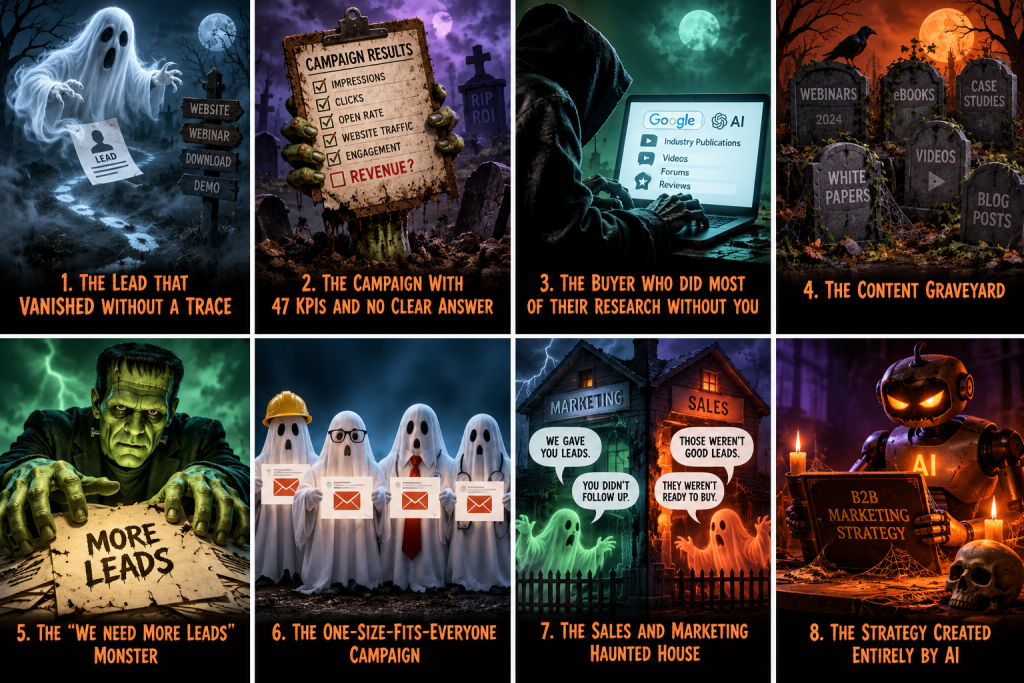
Image provided by ChatGPT
1. The Lead That Vanished Without a Trace
Someone downloads a guide. Attends a webinar. Visits your website. Maybe even comes back a few times.
Then…nothing.
The lead gets handed to sales, receives one or two emails, and quietly disappears into the CRM.
That is particularly frightening when you consider how long and complicated B2B buying cycles can be. A prospect who is not ready to talk to sales today may still be a valuable opportunity three or six months from now.
What is scarier than a cold lead? A good lead that became cold because nobody stayed in touch.
Lead nurturing should not end when the campaign does. Marketing needs a plan for continuing the conversation based on what prospects have shown interest in, where they are in their buying process, and what might help them take the next step.
That is also where lead nurturing programs such as BNP Media’s IgniteDemand can help. Instead of treating every content download, webinar registration or campaign response as a one-time interaction, IgniteDemand continues engaging prospects with relevant content from the industry brands they already know and trust. Marketers gain additional insight into who is engaging and showing increased interest, while prospects have more opportunities to move forward at their own pace.
Because sometimes the lead did not disappear at all. They just were not ready yet.
2. The Campaign With 47 KPIs and No Clear Answer
Impressions went up.
Clicks were strong.
The email had a great open rate.
Website traffic increased.
Everyone seems pleased until someone asks: “Did it generate any business?”
Cue the horror music.
B2B marketers have access to more data than ever, but more data does not automatically produce better measurement.
Before launching a campaign, decide what success actually looks like. Awareness may be the objective. Lead generation may be the objective. Pipeline contribution may be the objective.
The frightening part is reaching the end of a campaign and realizing nobody agreed on the objective in the first place.
3. The Buyer Who Did Most of Their Research Without You
Your prospects are researching long before they fill out a form or talk to a sales representative.
They are
- Searching Google
- Reading trade publications
- Watching videos
- Asking colleagues
- Comparing vendors
- Reading reviews
- And increasingly, they are asking AI tools for answers and recommendations
By the time someone raises their hand, they may already have a fairly developed opinion about your company.
That changes the job of B2B marketing.
Being visible only when someone is ready to buy is increasingly risky. Brands need useful, credible information available throughout the research process, including in the sources buyers and AI platforms rely on to form answers.
Because one of the scariest questions a marketer can ask today may be: “What does AI say about us?”
Followed closely by: “Does it mention us at all?”
4. The Content Graveyard
You know the place.
It’s filled with webinars from 2024, forgotten case studies, abandoned eBooks, old research reports, and videos that took six weeks to produce and received three promotional posts.
B2B companies spend considerable time and money creating content, then often treat publication as the finish line.
Good content should have a much longer life.
A webinar can become short videos, an article, social content, sales follow-up material, and nurture content. Research can support months of articles, presentations, and prospect conversations. A strong customer story can be useful throughout the sales process.
Of course, sometimes the problem is not what to do with existing content. It’s finding the time and resources to create enough useful content in the first place.
That is where Content as a Service can help. BNP Media can work with marketers to develop industry-specific content that supports their broader marketing goals, from articles and thought leadership to videos, research, and other resources. It gives marketing teams access to content expertise and industry knowledge without requiring everything to be produced internally.
And once that content exists, the same rule applies: do not let it disappear after one campaign. Build a plan to distribute it, repurpose it and keep putting it to work.
So, take a walk wandering through your content graveyard and see what’s worth bringing back to life.
5. The “We Need More Leads” Monster
It appears without warning. Usually near the end of a quarter.

Image provided by ChatGPT
Marketing launches another campaign, increases promotion and generates another list of names.
But sometimes the problem is not the number of leads. It’s what happens to them.
How quickly are leads followed up on? Are salespeople given useful context about what someone engaged with? Are leads being nurtured if they are not ready to buy? Can marketing see what eventually happens to them?
Generating more leads into a process that is not working simply creates a larger pile of neglected leads.
Before feeding the monster, make sure the system behind it is working.
6. The One-Size-Fits-Everyone Campaign
Same message.
Same offer.
Same email.
Same landing page.
Sent to everyone.
It’s certainly efficient. It is also increasingly easy for buyers to ignore.
A facilities manager researching a solution may care about something very different from an engineer, contractor, executive, or purchasing professional.
B2B marketing does not need to become endlessly complicated, but relevance matters. Industry, job function, previous engagement, stage in the buying process, and demonstrated interests can all help marketers determine what someone should hear next.
Sometimes the problem isn’t that your audience is not interested. They may simply not be interested in that message right now.
7. The Sales and Marketing Haunted House
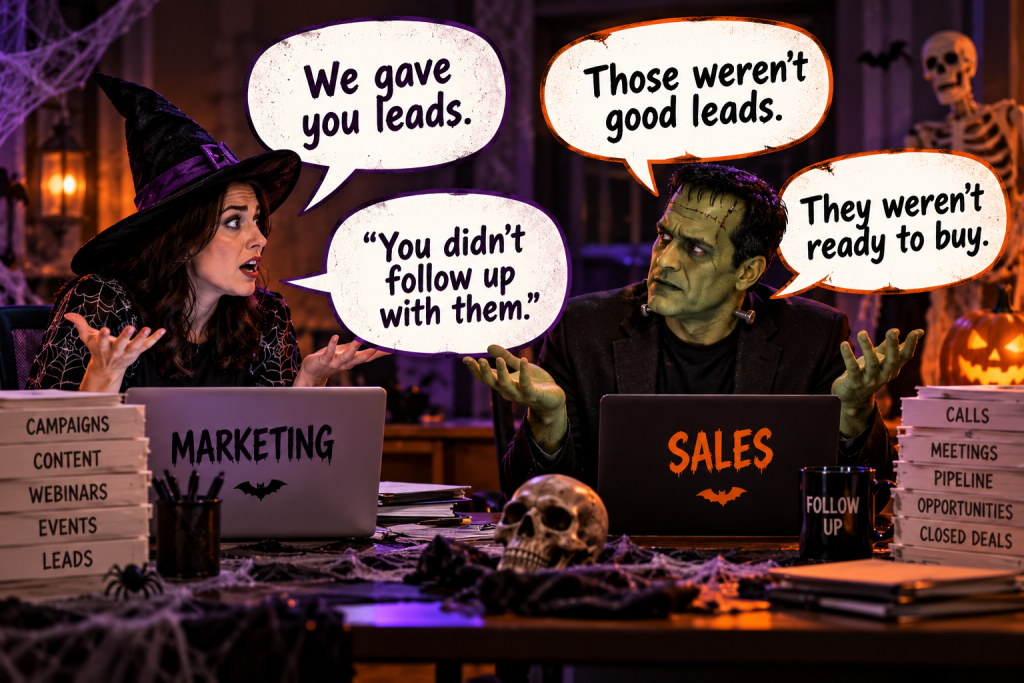
Image provided by ChatGPT
And around and around and around we go.
Few things create more trouble in B2B organizations than marketing and sales operating with different definitions of a qualified opportunity, different expectations and different information.
The cure is not another dashboard. It’s communication.
Marketing needs to understand what salespeople are hearing from customers. Sales needs visibility into what prospects are doing before they become opportunities. Both teams need alignment on what happens when someone shows intent.
Otherwise, everyone spends a lot of time trying to figure out who killed the lead.
8. The Strategy Created Entirely by AI
AI can help marketers research, brainstorm, analyze, write, and move considerably faster.
That does not mean it should make the decisions.
Ask an AI platform for a B2B marketing strategy and it can produce something remarkably polished in seconds.
It may also be completely wrong for your market.
AI does not sit in your sales meetings. It does not hear customers hesitate before answering a question. It does not automatically understand the history behind a product, the politics inside an organization, or why something that looks good on paper failed three years ago.
AI can accelerate judgment. It should not replace it.
The frightening part is not marketers using AI.
It’s marketers becoming so comfortable with the answer that they stop questioning it.
So, What Should B2B Marketers Actually Be Afraid Of?
Probably not AI.
Or changing algorithms.
Or the latest marketing technology.
The bigger risk is losing sight of the buyer while trying to keep up with everything else.
- Not understanding what they need.
- Not being present while they research.
- Not following up when they show interest.
- Not giving sales the information they need to continue the conversation.
- And not learning from what the data and your customers are telling you.
Those problems are considerably harder to fix than a bad email subject line.
Fortunately, unlike most horror movies (I still will not go in a lake when camping!), B2B marketers usually get another quarter to figure it out.
Happy Halloween.
Feature image provided by ChatGPT