AI has quickly become part of the marketing workflow. It is helping teams research, brainstorm, write, analyze data, personalize campaigns and complete work faster.
At the same time, something equally important is happening on the other side of the transaction: buyers are using AI, too.
That creates a different marketing environment. The question is no longer simply, “How should our marketing team use AI?”
Marketers also need to ask, “How do we market to customers who are using AI to make decisions?”
Buyers Are Researching Before They Reach You
Buyers have been conducting independent research for years, but generative AI can condense considerably more information into a single conversation.
Instead of visiting multiple websites, reading several articles and comparing vendors individually, a buyer can ask an AI platform to identify potential solutions, compare companies, explain differences and suggest questions to consider.
The shift is already measurable.
A Gartner survey of 645 B2B buyers found that 45% used generative AI during a recent purchase, primarily to gather information about vendors and products. Those buyers used an average of seven information sources during the purchasing process.
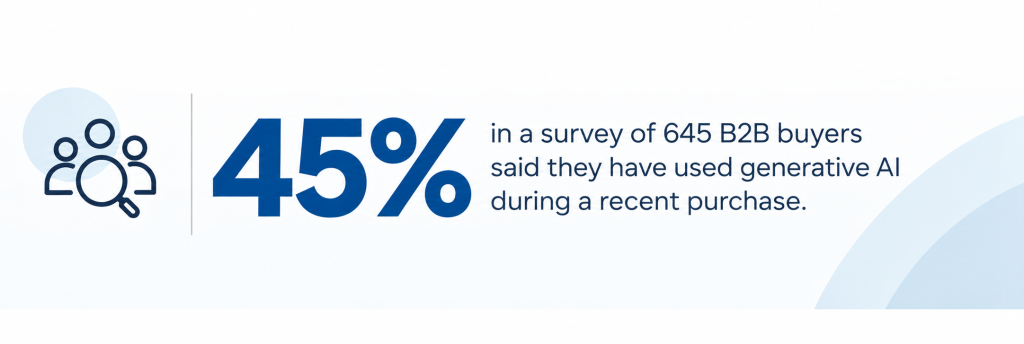
Image provided by ChatGPT
This means your website may no longer be a prospect’s first introduction to your company.
AI may introduce you first.
That makes the information available about your organization across the web increasingly important.
Your Content Has Two Audiences Now
For years, marketers have concentrated on creating content that could be discovered through search engines and consumed by people.
Now that content may also be interpreted, summarized and cited by AI systems.
Forrester describes this shift as moving from keywords toward context. Its research found that 95% of B2B buyers plan to use generative AI in at least one area of a future purchase, and more than half said generative AI led them to consider additional or different vendors while saving time during the buying process.
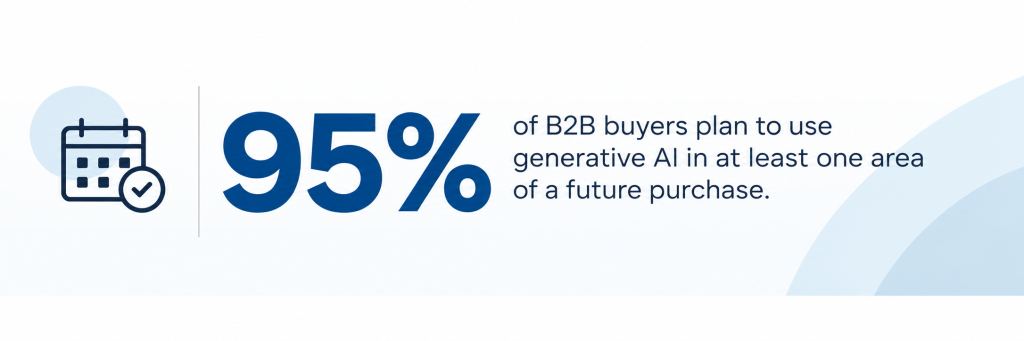
Image provided by ChatGPT
For marketers, this increases the value of content that clearly answers the questions buyers are asking.
A strong content strategy should include:
- Direct answers to common customer questions.
- Detailed product and service information that is accessible on webpages rather than buried exclusively in PDFs.
- Educational articles demonstrating subject-matter expertise.
- Case studies showing specific applications and results.
- Content attributed to identifiable experts within the company.
- Consistent information about the company across owned and reputable third-party sources.
The objective is broader than attracting another website visit. Your company needs enough credible, useful information available for buyers and the systems assisting them to understand who you are, what you know and where your organization fits within the market.
Authority Cannot Be Manufactured With More Content
The natural reaction to AI-powered search may be to produce more content.
AI certainly makes that possible.
HubSpot’s recent research of more than 1,000 marketing and advertising professionals found that 66% of marketers globally are already using AI in their roles. Ninety-one percent of marketing leaders said employees or teams within their organizations use AI to assist with their jobs.
Producing content is getting easier. Establishing authority is a different matter.
Publishing dozens of interchangeable articles does little to demonstrate why your organization should be trusted on a particular subject. Companies have a stronger opportunity to build authority around the knowledge that already exists within their organizations.
That could mean interviewing an engineer about a common technical problem, asking a product specialist to explain an overlooked consideration, having a company leader discuss a developing industry issue or turning a customer’s experience into a detailed case study.
The people within an organization have experiences, opinions and firsthand knowledge that cannot be replicated simply by asking AI to produce another article on the same subject.
AI can help those people communicate their expertise more efficiently. It should not become the expertise itself.
Human Interaction Still Matters When the Decision Gets Harder
The increasing use of AI does not necessarily mean buyers want people removed from the purchasing process.
The same Gartner research found an interesting division between research and decision-making. Although 67% of B2B buyers said they prefer an experience without a sales representative and 70% prefer digital self-service, 69% prefer to validate AI-generated information with a sales representative.
Additional Gartner research found that buyers were 32% more likely to say a sales representative made them feel confident about a purchase decision than generative AI. Buyers were also 39 percentage points more likely to say a salesperson understood their needs.
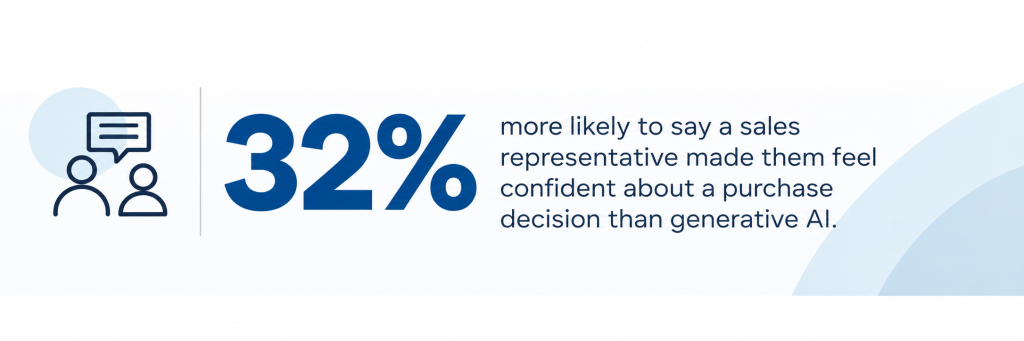
Image provided by ChatGPT
The roles appear to be separating.
AI and digital channels can help buyers gather information independently. People become particularly valuable when buyers need context, validation and help applying that information to their particular circumstances.
Marketing and sales strategies should account for both behaviors.
Give buyers enough information to research independently, while making knowledgeable people accessible when buyers are ready for a conversation.
AI Should Make Marketers Faster, Not Less Thoughtful
There is another side to this shift.
As buyers use AI to scrutinize companies, marketers are simultaneously using AI to create the material those buyers encounter.
That creates a tempting equation: If AI allows a marketing department to create five times as much content, then creating five times as much content must be better.
It is worth challenging that assumption.
Salesforce research found that 66% of marketers believe human oversight is necessary to use generative AI successfully. Seventy-one percent identified AI’s lack of human creativity and contextual knowledge as a potential barrier to successful use.
AI is very good at accelerating work. It can help marketers explore ideas, summarize information, analyze data, draft material and identify possibilities much faster.
Those capabilities do not eliminate the need to ask fundamental questions:
Does this idea make sense for our customer?
Is this information accurate?
Does this sound like our company?
Does the tactic support an actual business objective?
What evidence tells us this is working?
And perhaps most importantly: What have we learned from doing this before?
The Competitive Advantage May Be Judgment
Marketing has always involved experimentation.
AI can dramatically accelerate that process. A team can generate ideas, build variations, analyze results and make adjustments much faster than it could several years ago.
The value of the marketer increasingly sits in deciding what deserves to be tested, understanding what the results actually mean and determining what should happen next.
That requires experience, customer knowledge, data and judgment.
It also requires being willing to reject an AI-generated recommendation that sounds convincing but does not make sense for your market.
The companies that benefit most from AI may not be the ones that automate the largest percentage of their marketing. They may be the ones that become particularly good at determining where automation improves the experience and where human expertise improves the outcome.
Where Should Marketers Start?
You do not need to rebuild your marketing strategy around AI overnight. Start by examining how AI changes the way customers find, evaluate and interact with your organization.
Consider a few questions:
- Can someone quickly find clear answers to the questions customers commonly ask about your company?
- Is your best expertise visible online and attributed to actual people?
- Does your website contain useful information that AI systems and buyers can readily understand?
- Are reputable third parties talking about your company and its expertise?
- Are you using AI primarily to increase output, or is it helping improve the quality and effectiveness of your work?
- Where does a customer still benefit from speaking with someone who understands their particular situation?
- Are you measuring whether your marketing is producing better outcomes rather than simply producing more activity?
AI will continue to change the mechanics of marketing. The fundamentals of earning attention, establishing credibility, understanding customers and making informed decisions still matter.
In several respects, they may matter even more.
Hear How Marketers Are Navigating It
What does this look like for marketers dealing with these changes every day?
In the latest episode of Confessions of a Mad Marketer, BNP Media CMO Ben LeDonni talks with Crystal Williams, Co-Founder and Marketing Strategist at Lemon Seed Marketing, and Tyler Baber, Managing Director of BNP Engage, about the mistakes that shaped their approach to marketing, where AI is helping and hurting, how customer expectations are changing, and why human judgment remains so important.
Their conversation covers both B2C and B2B marketing, including AI-generated strategies, customer service, content, social media, authority, changing buyer behavior and the skills marketers will need as AI becomes a larger part of the job.
Getty Image Credit: ismagilov; Creative #: 2250495732