
Marketers spend a surprising amount of time debating email length.
Should every benefit be explained?
Should every feature be included?
Should you answer every possible objection before someone clicks?
The assumption is understandable. More information should create more confidence. Yet buyer behavior often suggests the opposite.
Today’s professionals scan far more than they read. Whether they’re checking email between meetings, on a mobile device, or while juggling multiple priorities, they decide within seconds whether an email deserves additional attention.
That raises an important question:
Does writing more actually generate better engagement?
To find out, we looked at results from multiple advertiser campaigns promoted through BNP Media brands. The answer was remarkably consistent.
We Tested One Variable: Copy Length
Across three recent advertiser campaigns, we created two versions of the same promotional email. Everything else remained consistent:
- Same audience
- Same creative
- Same offer
- Same subject line
- Same CTA
- Same send timing
The only meaningful difference was the amount of copy. One version included more detailed messaging. The other focused on fewer words, shorter paragraphs, and faster readability.
The Results
The pattern appeared across every campaign we tested.
Overall we saw:
- 40% average improvement in click-to-delivered rate (CTD)
- 41% average increase in ad clicks
Individual campaigns showed similarly strong gains.
For example:
- One campaign improved CTD from 0.25% to 0.40%, a 60% increase.
- Another improved CTD from 0.64% to 0.97%, a 52% increase.
- Ad clicks increased between 31% and 54% depending on the campaign.
While every audience behaves differently, seeing the same trend repeatedly gives us confidence that the change wasn’t simply random variation.
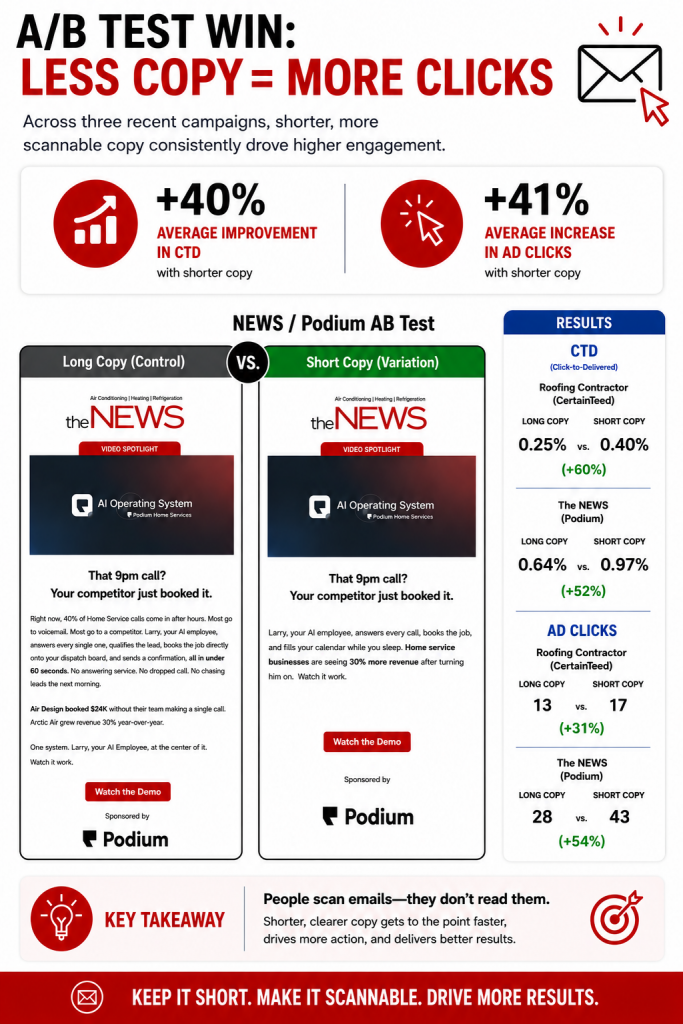
Results from three advertiser campaigns comparing long-form and short-form promotional email copy.
Why Less Copy Often Performs Better
This doesn’t mean buyers suddenly stopped caring about information. It simply means the email itself isn’t responsible for delivering all of it.
The primary job of most promotional emails is to create enough interest for someone to take the next step, maybe…
- Visiting a landing page
- Watching a video
- Downloading a guide
- Registering for a webinar
- Requesting more information
Trying to answer every possible question inside the email can actually reduce the likelihood that readers ever reach those destinations.
Instead, shorter copy respects how people consume email today. It allows readers to understand the value quickly and decide whether they want to learn more.
What Makes Shorter Emails More Effective?
Several factors likely contributed to the improved performance.
- They are easier to scan: Busy professionals rarely read emails from beginning to end. Headlines, short paragraphs, and concise messaging make it easier to identify what’s relevant.
- They reduce cognitive load: Every additional sentence requires another decision from the reader. And, keeping the message focused removes unnecessary friction.
- They create curiosity: Good marketing doesn’t answer every question immediately. It provides enough value to encourage the next click.
- They highlight the CTA: When copy is shorter, the call-to-action becomes more prominent instead of getting buried beneath several paragraphs.
Short Doesn’t Mean Incomplete
One important distinction is worth making. Shorter copy isn’t the same as weaker copy.
Every sentence should still earn its place. Effective short-form email copy typically includes:
- A clear problem
- A meaningful benefit
- Proof or credibility
- One primary call to action
Removing unnecessary words is about making every sentence work harder.
When Longer Copy Still Makes Sense
Like most marketing best practices, there isn’t a universal rule.
Longer emails may still perform well when:
- Introducing a highly technical product
- Explaining a complex solution
- Speaking to buyers who need extensive education
- Sharing thought leadership or research
The key takeaway is that marketers shouldn’t assume more copy automatically creates better results. The only reliable answer comes from testing.
What This Means for Advertisers
If you’re promoting your products or services to a BNP Media audience, your email creative deserves the same level of optimization as your targeting.
Small adjustments to copy structure can produce meaningful improvements in engagement without changing your audience, budget, or offer.
Before launching your next campaign, ask yourself:
- Could this message be simplified?
- Are the first few sentences doing the heavy lifting?
- Is the primary value obvious within seconds?
- Does every paragraph support the click?
Sometimes improving performance isn’t about saying more, but about making it easier for readers to understand why they should take the next step.
Final Thoughts
Every audience is different, and every campaign deserves testing. Still, after seeing the same outcome across multiple campaigns, one lesson became difficult to ignore.
People don’t read marketing emails the way they once did. They scan.
The brands that make their message easier to absorb often make it easier for buyers to act.
When in doubt, start with clarity, remove unnecessary words, and let the data tell you whether your audience wants more.
Want to improve the performance of your next email campaign?
BNP Media works with customers across many sectors, industries, and professions to test creative approaches, optimize messaging, and identify what drives stronger engagement with industry-specific audiences. Contact us to learn how we can help maximize the results of your next campaign.
Image by iLixe48, from Envato Elements